You press the brake pedal dozens of times on a normal drive without really thinking about it. The car slows down. You stop. You move on.
Then one morning you hear a squeal.
Or the steering wheel starts shaking when you brake. Maybe the pedal feels different. Maybe a shop tells you that you need pads, rotors, and something called a caliper, and suddenly a routine appointment turns into a much bigger conversation.
If you searched for brake repair change because you are trying to figure out what actually needs replacing, you are not alone. Brake service is confusing because there is no single component called “the brakes.” A modern braking system contains several parts, and they do not all wear at the same rate.
Brake pads are normal wear items. Rotors can last through more than one set of pads in some vehicles, while other cars may need pads and rotors together. Brake fluid ages differently. Calipers can last for years unless corrosion, damaged seals, or sticking hardware causes trouble.
And there is another issue: brakes are a safety system. This is one area where waiting for a problem to become obvious is not a great plan.
So here is what matters, without turning the subject into a mechanic’s textbook.
What Actually Happens When You Press the Brake Pedal?
Most passenger vehicles in the USA use hydraulic brakes. When you press the pedal, the brake system sends hydraulic pressure toward the wheels.
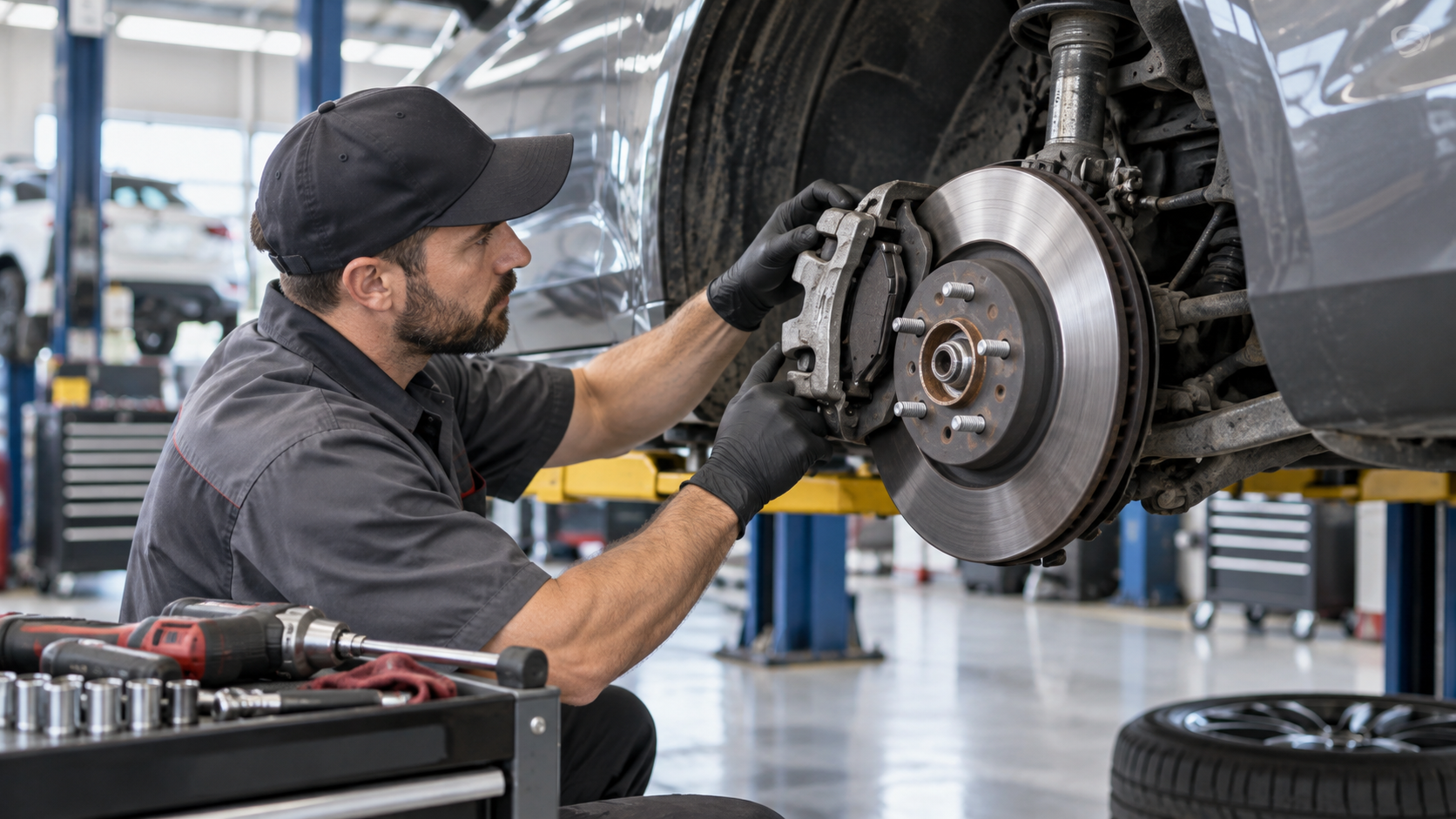
At a typical disc brake, that pressure causes the brake caliper to squeeze brake pads against a spinning rotor. The friction slows the rotor, which slows the wheel.
It sounds simple because, from the driver’s seat, it is simple.
Underneath the car, though, several parts have to cooperate correctly.
- Brake pads provide the friction material that presses against the rotors.
- Brake rotors provide the rotating surface that the pads clamp against.
- Brake calipers hold the pads and apply pressure to them.
- Brake fluid transfers hydraulic pressure through the braking system.
- Brake hoses and lines carry that fluid between major components.
- The master cylinder converts pedal movement into hydraulic pressure.
- ABS components help prevent wheel lock during hard braking on many modern vehicles.
If one component starts behaving badly, another component may also suffer.
A sticking caliper, for example, can keep a pad touching the rotor when you are not braking. That creates extra heat and can wear one pad much faster than the others.
This is why a good brake inspection matters more than automatically replacing whatever part is easiest to sell.
Brake Pads: The Part Most Drivers Replace First
Brake pads are designed to wear.
Every time you stop, a tiny amount of friction material disappears. Over thousands of miles, that adds up.
But there is no universal mileage at which every vehicle needs new pads.
A driver who spends every morning in city traffic may wear pads much faster than someone who drives long stretches of interstate highway. Vehicle weight matters too. So does driving style, terrain, brake design, pad material, regenerative braking on hybrids and EVs, and whether a caliper is working correctly.
That is why mileage estimates should be treated as rough guidance, not a countdown clock.
Actual pad thickness and condition tell you more.
How Do You Know Brake Pads Are Wearing Out?
Some symptoms are obvious. Others are subtle.
A high-pitched squeal can come from a wear indicator built into certain brake pads. But brakes can squeak for other reasons too, including moisture, dust, surface rust, pad composition, or glazing.
So noise alone does not automatically mean the pads are finished.
Grinding is different.
If you hear harsh metal-on-metal grinding while braking, the friction material may already be badly worn. Continuing to drive can damage rotors and reduce braking performance.
That is not the time to turn up the radio.
Warning Signs Worth Taking Seriously
- Grinding or scraping when braking
- A brake pedal that suddenly feels unusually soft or sinks farther than normal
- The vehicle pulling strongly to one side during braking
- Severe vibration through the pedal or steering wheel while braking
- A burning smell or excessive heat near one wheel
- A brake warning light that stays illuminated
- Visible brake fluid leakage
- Noticeably longer stopping distances
Some of these symptoms can have several causes. For example, vibration under braking may come from rotor thickness variation, suspension problems, wheel issues, or other mechanical conditions.
The symptom tells you something needs checking. It does not always tell you which part to buy.
Brake Rotors: Replace Them or Keep Them?
Brake rotors do not automatically need replacement every time pads are changed.
But there is a catch.
Rotors must remain within the vehicle manufacturer’s service limits. A technician may check rotor thickness, surface condition, runout, heat damage, cracking, rust, and wear pattern.
If a rotor is below its minimum allowable thickness, replacement is generally required.
Likewise, deep scoring, severe corrosion, heat damage, or other structural concerns can make replacement the safer decision.
Some rotors may be machined when enough material remains and the design permits it. But resurfacing has become less common on some modern vehicles because replacement rotors can be relatively affordable and certain factory rotors begin with less extra material available for machining.
There is no useful one-rule answer.
Measure first. Decide second.
Brake Pads vs. Rotors vs. Calipers
| Component | What It Does | Why It May Need Service |
|---|---|---|
| Brake pads | Create friction against the rotor | Normal wear, uneven wear, contamination, heat damage |
| Brake rotors | Provide the friction surface for the pads | Excessive wear, scoring, rust, heat damage, thickness variation |
| Brake calipers | Apply pressure to the brake pads | Sticking piston, damaged seal, corrosion, seized slide hardware |
| Brake fluid | Transfers hydraulic pressure | Age, contamination, moisture absorption, manufacturer service schedule |
| Brake hoses | Carry fluid to moving wheel assemblies | Cracking, internal damage, leakage, deterioration |
This distinction matters when comparing brake quotes.
One shop may quote pads only. Another may quote pads and rotors because the rotors have reached their service limit. A third may discover a seized caliper that caused the uneven wear in the first place.
Those estimates are not automatically contradictory.
The useful question is: what did the inspection show?
Why One Brake Pad Can Wear Faster Than the Others
Brake pads on the same axle generally should not show wildly different wear without a reason.
If one pad is almost gone while the others still have plenty of material, something else may be happening.
Caliper slide pins may be sticking. The caliper piston may not be moving freely. Hardware may be corroded. A brake hose can sometimes create hydraulic problems. Severe rust can also affect movement in areas exposed to road salt.
This is particularly relevant in parts of the USA where winter road treatments accelerate corrosion.
Simply installing new pads without fixing the cause can mean doing the same brake repair change again much sooner than expected.
Do Front Brakes Wear Faster Than Rear Brakes?
Often, yes, but not always.
During braking, vehicle weight transfers toward the front. On many conventional vehicles, the front brakes therefore handle a larger portion of the braking load.
That often means front pads wear sooner.
But modern brake systems can change the pattern. Electronic stability control may apply individual brakes. Some vehicles use rear brakes differently for stability functions. Hybrids and electric vehicles also combine regenerative and friction braking.
So do not assume the front brakes must always be the first set replaced.
What Is a Brake Caliper, and Does It Need Routine Replacement?
No. Brake calipers are not normally replaced on a fixed schedule like brake pads.
A healthy caliper can remain in service for a long time.
Problems begin when a piston sticks, a seal fails, corrosion becomes severe, or slide hardware stops moving correctly.
A stuck caliper can make the vehicle pull while braking. It may create a burning smell, excessive brake dust, unusually rapid pad wear, or a wheel that becomes much hotter than the others.
That heat can damage pads, rotors, wheel bearings, and nearby components if the problem becomes severe.
If one wheel feels extremely hot or smoke appears, stop driving and have the vehicle inspected safely.
Brake Fluid Is Easy to Forget
You cannot see brake fluid wearing away the way you can see a brake pad getting thinner.
That is one reason drivers forget about it.
Most automotive brake fluids are hygroscopic, meaning they can absorb moisture over time. That can affect boiling performance and contribute to internal corrosion under certain conditions.
Service recommendations vary significantly among manufacturers.
Some manufacturers specify a time-based brake fluid interval. Others call for inspection or testing rather than replacement at one universal mileage.
Follow the service schedule for your vehicle rather than relying on a generic “every two years” or “every 30,000 miles” rule from the internet.
What About ABS?
ABS stands for anti-lock braking system.
Its job is to help prevent wheel lock during heavy braking so the driver can retain more steering control.
Modern ABS systems use wheel-speed sensors, hydraulic components, electronic controls, and often share information with stability-control and traction-control systems.
An illuminated ABS warning light does not necessarily mean your basic hydraulic brakes have completely stopped working. But the anti-lock function may be unavailable, and the warning can indicate a fault that deserves diagnosis.
If the red brake warning light appears, particularly with a changed pedal feel or low fluid level, treat the situation more urgently.
Can You Keep Driving With Worn Brakes?
That depends on what “worn” means.
Brake pads approaching their recommended replacement thickness are very different from brakes already grinding metal against metal.
If a routine inspection shows that pads are nearing the end of their service life, you may have time to schedule an appointment.
If braking performance has changed noticeably, fluid is leaking, the pedal becomes soft, grinding is severe, or a wheel is overheating, continuing to drive may be unsafe.
When in doubt, have the vehicle inspected rather than trying to squeeze another week out of it.
Brakes are a strange place to gamble for convenience.
How Much Does Brake Repair Cost in the USA?
There is no single nationwide brake repair price.
Labor rates vary by city and region. A luxury SUV with large performance brakes may cost several times more to service than a compact commuter car.
Parts quality matters too.
A basic aftermarket pad set, premium ceramic pads, performance rotors, electronic parking brake components, and factory parts can all produce very different totals.
Instead of focusing on one advertised number, look at what the quote actually includes.
| Service | What Usually Affects the Price |
|---|---|
| Brake pad replacement | Vehicle design, pad material, labor time, axle being serviced |
| Pads and rotors | Rotor size, rotor type, number of parts, labor |
| Caliper replacement | Caliper type, electronic features, bleeding requirements, parts availability |
| Brake fluid service | Fluid specification, system design, shop procedure |
| ABS diagnosis | Diagnostic time, sensor access, hydraulic or electronic fault |
A low quote is not necessarily a bargain if it leaves out rotors that are below specification, required hardware, or the cause of abnormal wear.
On the other hand, expensive does not automatically mean necessary.
Ask for measurements.
Questions to Ask When a Shop Recommends Brake Work
- How much brake pad material is left?
- Are both sides wearing evenly?
- What is the measured rotor thickness?
- What is the minimum rotor thickness for this vehicle?
- Is there scoring, corrosion, cracking, or heat damage?
- Are the calipers and slide pins moving correctly?
- Does the vehicle need brake fluid service according to its maintenance schedule?
- What parts and labor are included in the estimate?
- Is the quote for one axle or all four wheels?
A trustworthy shop should be able to explain why a component is being recommended.
You do not need a mechanical engineering degree. Numbers, photos, and a simple explanation are enough.
Should Brake Pads Be Replaced in Pairs?
Brake pads are generally serviced as an axle set.
That means both front wheels or both rear wheels receive pads together.
Replacing pads on only one wheel can create inconsistent friction characteristics and does not address why one side wore differently.
If one pad is substantially more worn than its partner on the same axle, a technician should look for the cause rather than simply replacing one side.
What Are Ceramic Brake Pads?
Ceramic is one of several common brake pad friction-material categories.
Ceramic pads are popular on many passenger vehicles because they can offer quiet operation and relatively low visible brake dust.
But they are not automatically right for every car.
Semi-metallic or other friction formulations may be specified or preferred depending on vehicle design, braking demands, towing, performance use, temperature requirements, and manufacturer recommendations.
The correct pad is the one suited to the vehicle and its intended use.
Why New Brakes Sometimes Make Noise
People expect new brakes to be absolutely silent.
Usually they are quiet, but fresh pads and rotors sometimes make temporary noises while surfaces settle in.
Installation problems can also create noise. Missing or damaged hardware, incorrect lubrication of designated contact points, poor pad fit, rust buildup, contamination, and unsuitable friction material can all play a role.
Some performance-oriented brake pads naturally make more noise than comfort-focused street pads.
If new brakes grind, pull, overheat, or make severe noises, return to the shop rather than assuming it is normal break-in behavior.
What Is Brake Bedding?
New brake pads and rotors need compatible working surfaces.
Some manufacturers or pad makers specify a bedding or burnishing procedure after installation. This can establish an even friction-transfer layer and help the brake system perform consistently.
The required procedure varies by vehicle and friction material.
Do not copy an aggressive performance-car bedding routine from a random video and apply it to every daily driver.
Follow the instructions for the parts installed.
Why Does the Steering Wheel Shake During Braking?
Drivers often call this “warped rotors.”
Rotor problems can absolutely create braking vibration, but the phrase does not describe every case accurately.
Variation in rotor thickness, uneven friction deposits, excessive runout, corrosion, hub contamination, wheel bearing issues, and suspension problems can all produce similar sensations.
Diagnosis matters.
If vibration occurs primarily during braking, brake components should be inspected. If the vibration is present at speed even without braking, tires, wheels, alignment, or suspension may also be involved.
Why Does the Brake Pedal Feel Soft?
A soft or spongy pedal deserves attention.
Possible causes include air in the hydraulic system, fluid leakage, deteriorated hoses, problems within the master cylinder, overheated brake fluid, or other hydraulic faults.
This is not something to diagnose by repeatedly pumping the pedal and hoping it improves.
If the pedal suddenly feels substantially different, particularly if it approaches the floor, avoid unnecessary driving and have the system checked promptly.
Does Brake Fluid Normally Go Down?
The fluid level can gradually change as brake pads wear because caliper pistons sit farther outward.
But a sudden or significant drop in brake fluid can indicate leakage.
Do not automatically top off a low reservoir and forget about it.
Find out why it is low.
If the braking system is leaking fluid, that can become a serious safety problem.
Can Brakes Rust From Sitting?
Yes.
Light surface rust can develop on brake rotors surprisingly quickly after rain, washing the car, or simply parking in humid conditions.
A thin orange film that disappears after normal braking is often nothing unusual.
Heavy corrosion is different.
A vehicle parked for months may develop deeper rotor rust, especially in humid or coastal climates or areas where road salt is common.
Electric and hybrid vehicles can also develop rotor corrosion because regenerative braking may reduce how often the friction brakes work heavily.
Electric Vehicles Still Have Friction Brakes
Electric vehicles use regenerative braking to recover energy, but they still have conventional friction brakes for situations where more braking force is needed or regenerative braking is unavailable.
That can mean brake pads last a surprisingly long time.
Long life does not eliminate maintenance.
Calipers can still stick. Brake fluid still needs attention according to manufacturer guidance. Rotors can corrode. Electronic parking brake mechanisms also need to work correctly.
Low mileage on the pads is not the whole story.
Can You Replace Brakes Yourself?
Experienced DIY owners sometimes replace brake pads and rotors at home.
But brake work has little room for improvisation.
The vehicle must be lifted and supported safely. Fasteners may have specific torque requirements. Some rear brakes require an electronic service mode. Caliper pistons can require special procedures. Hydraulic work requires correct bleeding.
ABS and electronic parking brake systems can add another layer.
If you are unsure about the procedure, tools, or safety requirements for your exact vehicle, professional brake service is the sensible option.
A brake repair tutorial is not the ideal place to learn by trial and error.
Cheap Brake Parts: Are They Worth It?
Not every inexpensive part is bad, and not every expensive part is brilliant.
But friction material quality matters.
Poorly matched pads may create excessive dust, noise, uneven wear, poor pedal feel, or disappointing braking characteristics.
Rotors also vary in metallurgy, corrosion protection, machining quality, and manufacturing consistency.
For a normal daily driver, a reputable OE-equivalent part is usually a sensible target.
You do not necessarily need track-day brakes for the school run.
How to Make Brakes Last Longer
Driving style makes a noticeable difference.
Look ahead and release the accelerator earlier instead of charging toward every red light and braking hard at the last second.
Maintain a reasonable following distance. Avoid carrying unnecessary heavy loads. Have sticking brakes repaired quickly. And do not ignore strange noises until they become grinding.
It is not about driving painfully slowly.
Smooth driving simply creates less heat and friction.
Brake Repair Change FAQ
How often should brake pads be changed?
There is no universal mileage interval. Pad life depends on vehicle weight, driving style, terrain, brake design, traffic, pad material, and system condition. Have pad thickness checked during routine maintenance and replace them before they fall below the manufacturer’s service limit.
Do rotors need to be replaced every time brake pads are changed?
No. Rotors can sometimes remain in service if they are within specification and their surfaces are suitable. Rotors that are too thin, damaged, heavily corroded, or otherwise outside service limits should be replaced.
Can I drive when my brakes are grinding?
Grinding may indicate that the friction material is severely worn. Continuing to drive can increase stopping risk and damage additional components. Arrange an inspection promptly rather than treating the noise as normal wear.
Why do my brakes squeak if the pads are still good?
Brake noise can come from moisture, dust, surface rust, friction-material characteristics, glazing, hardware, contamination, or vibration between components. Pad thickness is only one part of the diagnosis.
Should front and rear brakes be replaced at the same time?
Not necessarily. Front and rear brakes often wear at different rates. Replace components based on their measured condition and manufacturer service limits rather than automatically replacing all four corners.
How do I know if a brake caliper is bad?
Possible signs include uneven pad wear, pulling while braking, excessive heat from one wheel, a burning smell, abnormal brake dust, fluid leakage, or a wheel that does not rotate freely. A proper inspection is needed to confirm the cause.
Is brake fluid replacement part of a normal brake repair change?
Sometimes, but not automatically. Brake fluid service follows the vehicle manufacturer’s maintenance guidance and the condition of the fluid. Replacing pads does not always mean the brake fluid must be replaced at the same appointment.
Conclusion
Brake maintenance sounds simple until someone starts listing pads, rotors, calipers, hoses, brake fluid, and ABS components on the same estimate.
But the basic idea is easier than it looks.
Brake pads wear because they create friction. Rotors wear because the pads work against them. Calipers apply the pressure. Brake fluid transfers it. The rest of the system keeps that process controlled and predictable every time you press the pedal.
The useful approach to brake repair change is not replacing everything automatically.
Inspect. Measure. Find the reason for unusual wear. Then repair what actually needs attention.
If pads are thin but the rotors remain healthy and within specification, the job may be straightforward. If one pad has disappeared while the others still look good, there may be a caliper or hardware issue behind it. If the pedal feels soft or fluid is leaking, the problem moves from normal wear into something more urgent.
And that difference matters.
Brake noises also deserve a little context. A brief squeak on a damp morning is not the same thing as grinding every time you stop. Light surface rust is not the same as deep rotor corrosion. A routine wear warning is not the same as a pedal suddenly dropping toward the floor.
You do not need to panic every time the brakes make a sound.
But you should pay attention when the behavior of the car changes.
When a shop recommends brake work, ask for the pad thickness, rotor measurements, and explanation of any uneven wear. Those three pieces of information can make an estimate much easier to understand.
And remember that brake prices cannot be compared properly unless the jobs are actually the same.
A $250 quote for pads alone and a $600 quote for pads, rotors, hardware, and additional labor are not directly comparable. Read the estimate before deciding one shop is expensive and another is cheap.
Quality matters too.
Your daily commuter does not need race-car brake components, but it does need correctly matched parts from a reputable source, installed according to the vehicle manufacturer’s procedures.
That is especially important on newer cars with electronic parking brakes, advanced ABS systems, brake-by-wire elements, regenerative braking, or specialized service procedures.
If you perform brake work yourself, make sure you have the vehicle-specific instructions, proper tools, safe lifting equipment, and correct torque information. If any part of the hydraulic or electronic system is outside your experience, professional service is the safer route.
There is no prize for turning a safety repair into an experiment.
Finally, do not wait for dramatic symptoms before thinking about brakes.
Routine inspections can catch thin pads, corrosion, torn boots, leaking components, and uneven wear while the repair is still relatively simple.
That is the ideal brake repair change: planned maintenance instead of a grinding noise in traffic and a last-minute trip to the shop.
Brakes rarely need much attention from the driver’s seat.
They just need the right attention at the right time.

Leave a Reply